
What players say
Domino Hexa Puzzle does one thing clearly: it takes domino matching and rebuilds it on a hexagonal grid. The extra neighbor connections make placement decisions matter more, since a careless tile can cut off several chains at once. Hundreds of puzzles and a progressive curve give it staying power, and the HTML5 build means it runs without downloads. The main limitation is that the input does not describe audio, story, or multiplayer, so it is best approached as a quiet solo logic exercise rather than a social or narrative game.
About this game
Matching on a Hexagonal Grid
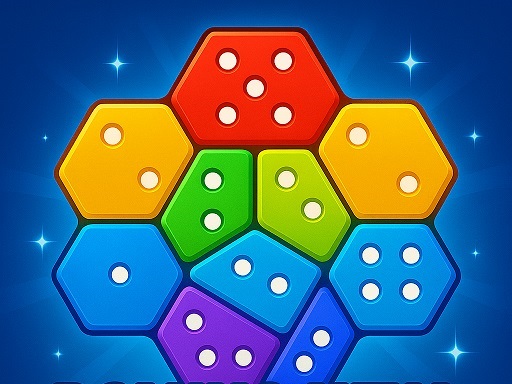
Domino Hexa Puzzle takes the familiar domino-matching rule and places it on a board made of hexagon-shaped cells. Each domino tile must connect to adjacent tiles by matching values, forming chains that eventually clear the board. Because each hexagon touches six neighbors instead of four, every placement opens more potential connections than a square grid would — and more ways to trap yourself if you commit too early.
How a Turn Works
On desktop, click a domino to select it, then drag it to the target cell. On a touchscreen, tap and drag with a finger. The goal is to match each domino with adjacent tiles to create connections and clear the board. Each level presents a unique layout, so the challenge shifts from simple matching to planning several moves ahead. [IMG_1]
Difficulty and Progression
The game offers hundreds of puzzles with a progressive difficulty curve. Early boards tend to have more obvious matches; later layouts demand stronger logic and spatial reasoning. Hints may be available for tough puzzles, but using them sparingly preserves the challenge. The primary appeal is finding solutions independently.
Platform and Accessibility
Built with HTML5, Domino Hexa Puzzle runs directly in a modern web browser without downloads or installations. It is unblocked, so it can be played on school or work networks. The colorful 2D design and smooth controls aim to make it accessible to children and adults alike, and the game is designed as a safe, family-friendly environment for casual play and mental exercise.
Tips for Better Solving
Start by scanning the board for obvious matches. Before placing a tile, check whether it blocks a key area or cuts off a chain you will need later. Practice regularly to build pattern recognition, and stay patient — efficient placement comes from reading the whole board, not just the nearest empty cell.
Compatibility
FAQ
Player comments
Sign in to comment
You must be logged in before posting a review or rating.
No comments yet. Be the first to comment!






Editorial Notes