
What players say
Wild West Solitaire Classic does not reinvent solitaire; it dresses the standard rules in a saloon setting and keeps the focus on careful sequencing. The alternating-color tableau, four suit foundations, and stock pile draw will be immediately familiar to anyone who has played traditional solitaire. The Western theme gives the layout a specific atmosphere, and mouse or touchscreen support makes it accessible across devices. Players who prefer planning over speed will get the most from it.
About this game
Saloon-Style Solitaire
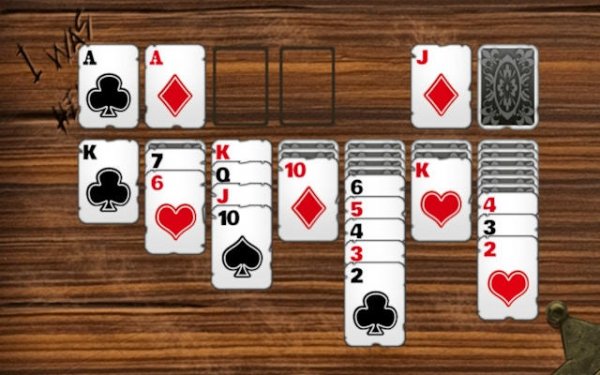
Wild West Solitaire Classic takes the standard rules of traditional solitaire and places them inside a virtual saloon. The goal is unchanged: move every card from the tableau into four foundation piles, one for hearts, one for diamonds, one for clubs, and one for spades. Each foundation pile must be built in ascending order, beginning with the Ace and ending with the King. The Western design elements give the familiar layout a distinct visual identity without altering the underlying card logic.
Reading the Tableau
The tableau holds cards in several columns. Within those columns, cards are arranged in descending order and must alternate between red and black suits. Players can shift cards between tableau columns or send them directly to a foundation pile when the sequence allows. Face-down cards in the tableau can only be revealed once the cards above them are moved away, so each decision affects what becomes available later. [IMG_1]
Stock Pile and Session Flow
When no useful move remains on the tableau, players draw from the stock pile to bring new cards into play. The session ends when every card has been transferred to the foundation piles. Mouse clicks and touchscreen taps handle all interactions, so the same layout works on desktop computers, tablets, and smartphones without a separate control scheme.
Planning Over Speed
Success depends less on quick tapping and more on sequencing. Uncovering face-down cards early tends to create more options than clearing visible cards for its own sake. Moving cards to the foundation too soon can also backfire, because those cards may still be needed to build tableau sequences. Patience and pattern recognition matter more than reaction time, which keeps the game approachable for newcomers while still rewarding experienced solitaire players.
Compatibility
FAQ
Player comments
Sign in to comment
You must be logged in before posting a review or rating.
No comments yet. Be the first to comment!






Editorial Notes