
What players say
Urban Tint Takedown Arcade builds its challenge around one readable rule: convert smaller groups, avoid larger ones. The two-minute stage limit forces quick decisions, and the bright, simple visuals keep threats easy to assess. Progression adds larger groups and tighter layouts without changing the core loop. This suits players who enjoy short, repeatable puzzle-action rounds. The lack of story or long-term unlocks is a limitation for anyone seeking deeper progression.
About this game
Color Conversion as a Core Mechanic
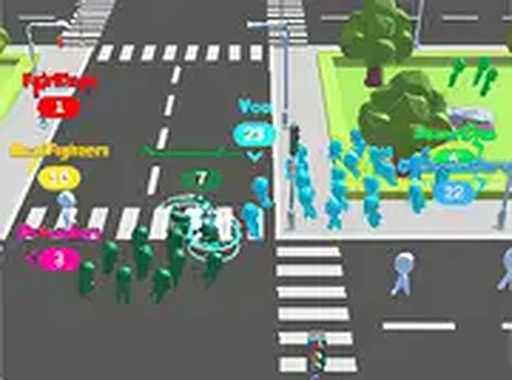
In Urban Tint Takedown Arcade, every character you meet belongs to one of three states: neutral white, your color, or an opponent's color. Touching a white character adds it to your group and increases your count. Colored characters are opponents, and you can only convert them if your current number is larger than theirs. This simple rule creates a constant calculation: approach, compare, and decide. The game never hides the numbers, so the tension comes from reading the crowd correctly rather than from reflex alone.
Two-Minute Pressure and Risk Management
Each stage gives you exactly two minutes. That timer removes any option to play slowly. Neutral whites are safe points, but opponents offer bigger swings if you have the numbers. The strategic layer is knowing when to build up with neutrals and when to challenge a colored cluster. If you touch a larger group, you are removed from the stage immediately. That failure state is harsh but clear, and it makes every approach a deliberate choice rather than an accident.
Visual Clarity and Controls
The game uses bold colors and simple 3D graphics in a cheerful urban setting. Character color is the only information you need to assess a threat, which keeps the screen readable even when many characters are moving. Full-screen mode removes distractions. Movement uses arrow keys or WASD, while the mouse handles menus and option selection. No special hardware is required, and the control scheme is easy to learn without limiting efficient movement for experienced players.
Progression and Session Structure
Later stages introduce larger opponent groups, tighter time pressure, and more complex layouts. The difficulty curve is gradual, so each new stage feels like a fresh puzzle rather than a sudden spike. Because a round lasts only two minutes, the game suits short sessions. There is no story or long-term progression system to manage, which keeps the focus on immediate decisions and repeated attempts to improve your approach.
Compatibility
FAQ
Player comments
Sign in to comment
You must be logged in before posting a review or rating.
No comments yet. Be the first to comment!








Editorial Notes