
What players say
Path Puzzle: Detective Challenge delivers a focused spatial reasoning challenge without violence or time pressure. The no-crossing rule turns simple path drawing into a coordination puzzle, and the gradual difficulty curve keeps it accessible for all ages. It lacks character variety or complex features, but that restraint suits its pick-up-and-play design. Best for players who enjoy planning several moves ahead.
About this game
Connecting Detectives to Targets
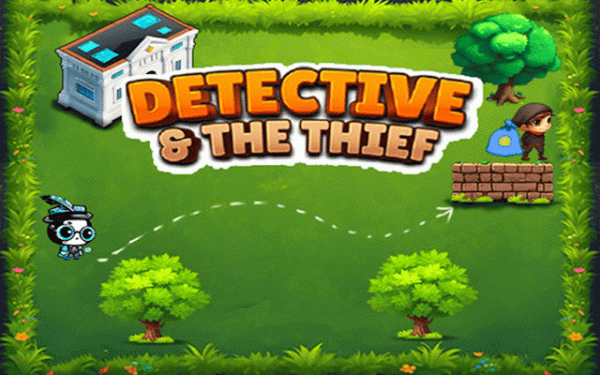
Path Puzzle: Detective Challenge asks you to draw a continuous line from each detective to a target of the same color—typically a thief or a treasure bag. Targets may sit behind walls or other obstacles, so the route is rarely a straight shot. The core loop is simple: observe the grid, identify matching pairs, and sketch a path that reaches the goal without touching alarms or blocked tiles.Why Paths Cannot Cross
The defining rule is that paths for different detectives must never intersect. This turns each puzzle into a coordination problem rather than a series of independent routes. You cannot solve one detective at a time in isolation; a valid path for one may cut off another. The no-crossing constraint forces you to think about the whole board, plan the order in which you draw, and leave enough room for every connection.Difficulty That Grows with the Grid
Early puzzles use small grids and few detectives, which teaches the basics of color matching and hazard avoidance. As you progress, the game introduces more detectives, more obstacles, and tighter spaces. The increase in complexity is gradual, so the challenge comes from needing more foresight rather than from sudden rule changes. Each new scenario demands that you look several moves ahead before drawing a single line.Approachable for All Ages
There is no violence, timer pressure, or inappropriate content. The game is built around spatial reasoning and problem-solving, making it suitable for families and casual players who enjoy a mental workout. Because the mechanic is easy to understand—draw a line, avoid hazards, don't cross—you can start playing immediately, but the later puzzles are hard to master without patience and planning.Compatibility
✅ Works on PC & Mobile | Recommended: Chrome / Safari / Edge
FAQ
Does Path Puzzle: Detective Challenge have a time limit on puzzles?
The input does not mention any timer or time pressure. The game is described as a clean, non-violent challenge focused on problem-solving and spatial reasoning. You can take as long as you need to plan routes before drawing, which supports the family-friendly, accessible design.
Can I undo a path if I make a mistake in Path Puzzle: Detective Challenge?
The provided information does not specify an undo feature. The game emphasizes planning routes before drawing, suggesting that careful forethought is the intended approach. If you draw an invalid path, you likely need to restart or redraw that route, so planning ahead is strongly recommended.
Are there different detective characters or just one?
The description refers to multiple detectives in a single puzzle, each needing a separate path to a matching target. It does not mention unique character abilities or selectable detectives. The focus is on the path-drawing mechanic and the no-crossing rule, not on character variety.
What happens if a path touches an alarm or blocked tile?
According to the game introduction, hazards such as alarms or blocked tiles can end the pursuit. That means the path is invalid and you must redraw it. Avoiding these tiles is a core part of the challenge, and later puzzles place them to force longer, more careful routes.
Is Path Puzzle: Detective Challenge suitable for children?
Yes. The game is described as family-friendly, non-violent, and suitable for all ages. It contains no inappropriate content. The puzzles rely on logic and spatial reasoning, so children can play, though later levels may require adult-level planning and patience.
How does the game increase difficulty over time?
The input states that puzzles increase in complexity, with each new scenario requiring more foresight and careful planning. Early puzzles teach the basics, then gradually introduce more detectives, obstacles, and tighter grids. The no-crossing rule becomes harder to satisfy as the board fills up.
Player comments
Sign in to comment
You must be logged in before posting a review or rating.
No comments yet. Be the first to comment!







Editorial Notes